 In our recent look at host destination selection, we explored what planners evaluate when choosing the right city for an event. And while hotels are a pivotal piece of that initial decision, building the actual hotel program requires balancing an entirely new set of considerations.
And that’s where opinions often begin to differ.
Ask five event professionals what makes a great hotel program, and you’re likely to get five different answers.
Is it the lowest rates? The closest hotels? The largest room block?
Truth is, none of those metrics tells the whole story. Competitive rates are the primary driver of in-block booking, but a well-balanced hotel program delivers value far beyond the nightly rate. Price and location are often deciding factors for eventgoers. But for organizers, a hotel program can represent something much larger. It influences attendee and exhibitor satisfaction, participation within the official block, and ultimately the overall performance of the event itself.
It’s About More Than a Place to Sleep: The Attendee Experience
For many, the hotel experience shapes their perception of the event just as much as the programming itself. Location affects convenience. Pricing affects accessibility. Availability can influence participation.
In fact, industry thought leaders increasingly view every attendee touchpoint as part of the broader event journey, from pre-event planning through the onsite experience and beyond.
That’s why, when shaping their hotel program, planners often evaluate a broad range of considerations, including:
- Walkability and convenience
- Diversity of brands and price points
- Availability across event dates
- Networking opportunities
- Proximity to key event functions
- Transportation options
- Accessibility considerations
The challenge is that each component could come with a trade-off. Concentrating attendees in a few hotels might strengthen community and networking opportunities, while a broader hotel package may provide greater choice and affordability. Neither approach is inherently right or wrong. The best solution depends on the goals and priorities of the event.
Balancing Competing Priorities
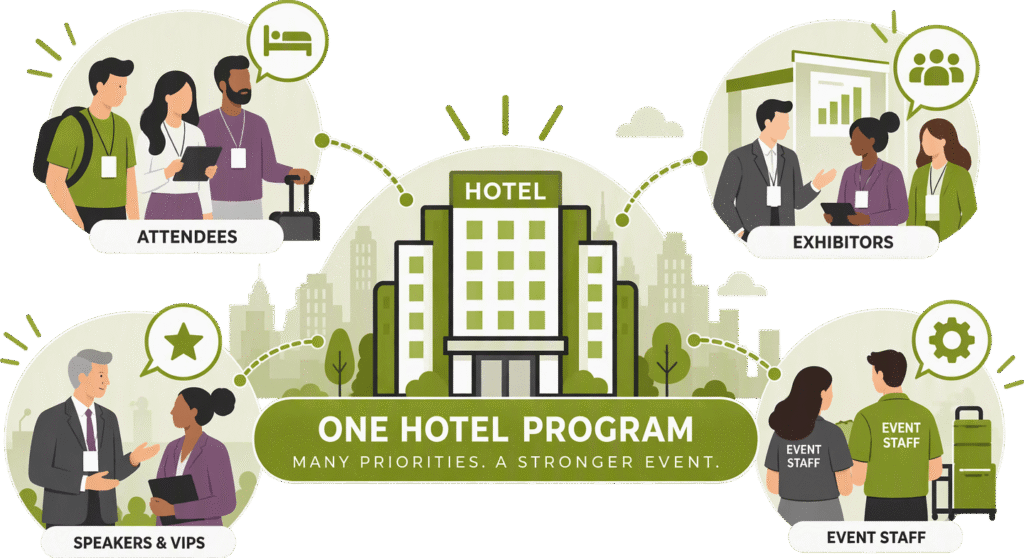 Attendees aren’t the only ones a hotel program serves. Exhibitors often have distinctly different needs, including larger teams, longer stays, and changing travel plans.
Sponsors, speakers, hosted buyers, and VIPs bring another layer of complexity. Executive meetings, hosted buyer programs, board events, and speaker accommodations may require a different level of service and proximity.
Event staff introduce yet another set of priorities. Proximity, cost management, access to key venues, and staffing requirements can all factor into the equation.
A program that works exceptionally well for one audience may create challenges for another. Thoughtfully constructed hotel programs recognize these competing priorities and seek to balance them rather than optimize for a single outcome.
The Economics Start Long Before Reservations Open: Contracts, Concessions, and Commitments
While much of the attention naturally centers on room pick-up, the economics of a hotel program are often shaped long before the first reservation is made. The concessions, protections, and operational elements of each hotel contract can have a significant impact on both event performance and financial outcomes.
Those factors often include:
- Financial considerations
- Complimentary rooms and staff rates
- Meeting space requirements
- Cancellation protections
- Attrition provisions
- Room block commitments
None of these diminish the importance of room rates. Competitive rates remain one of the strongest incentives for booking in the official block, but they’re only one piece of the equation. Two hotel programs may offer similar room rates while delivering very different levels of flexibility, risk protection, and overall value.
The Hidden Role of Risk Management in a Hotel Program
Every event operates in an environment of uncertainty. In fact, many industry leaders now argue that uncertainty is no longer the exception; it’s become the planning environment itself.
Attendance projections change. Travel patterns shift. Market conditions evolve.
As a result, hotel programs increasingly serve as risk-management tools.
Questions surrounding contract flexibility, room commitments, cancellation protections, and contingency planning receive the same attention as rates and blocks, as they can significantly impact performance and financial outcomes. The best programs are often those that balance opportunity and protection rather than maximizing one at the expense of the other.
Great Hotel Programs Are Built Around Balance
While it’s tempting to think there is a one-size-fits-all solution, every decision involves a potential tradeoff. A citywide trade show, a medical meeting, and a corporate user conference may each require a completely different approach. What works for one event could be entirely wrong for another.
Room rates will always matter, but a well-balanced hotel program delivers value across the entire event ecosystem. The best programs align hotel strategy with the broader goals of the event, creating a better experience for event participants while supporting the objectives of the organizer.
This aligns with broader event industry research, which increasingly measures success through engagement, connection, experience, and long-term event value rather than any single operational metric.
Want to continue the conversation?
Every event has its own priorities, audience expectations, and definition of success. If you’re navigating hotel strategy for an upcoming event and would like to continue the conversation, we’d love to hear from you.
Contact us at [email protected].